Yesterday evening was the much awaited Polynesian Feast. We started off the night with drinks up at the Gump House, where the legendary Gump, who donated the research station to Berkeley, used to spend his time. Neil Davies, director of the station and known to have once dated Miss Tahiti, now lives there. This house is absolutely amazing. First off, the view is astounding: it’s up in the hills, so you can see the entire bay from the huge bay windows and lovely outdoor patio. The living room, kitchen, bedrooms, and bathroom are all in separate little huts carved of wood and stone. The living room is full of traditional Tahitian style furniture and decorations, and the odd “Go Bears” and “Cal” banners hanging around, quite a funny juxtaposition. After two hours of wine and beer, half of which I spent talking to one of the heads of the NSF (National Science Foundation, which gives huge grants to students for research)who was visiting the Pacific stations, we headed down to the Fare Pote’e (our outdoor hut) for the feast. The Polynesians had prepared us all kinds of traditional fare: chicken and some kind of pork and cabbage dish (cooked in the ground for hours), poisson cru (“raw fish,” a dish of uncooked fish marinated in lime and coconut juice), taro, bread fruit (anyone seen Mutiny on the Bounty? Captain Bligh would have been jealous), banana mush stuff (no idea what it’s called), some other starchy root vegetables, and the much anticipated fafaru, a traditional dish of uncooked fish in fermented sea water (in which fish has been allowed to rot for a few days). I decided that since this might be my only chance to ever eat any of this stuff, I would forego my vegetarian ways and try a bite of everything. The fafaru was actually not as horrible as expected, although I think we were given a mild version – it basically tasted like chewy, salty sea water. Bread fruit is quite strange: it’s a huge green fruit (about the size of a football) that grows on a tree yet tastes a lot like potato (when fried, it tastes like fries); this was what Captain Bligh and his crew came to Tahiti for the 1700s, as the goal was to bring it to the Caribbean to feed the slaves.
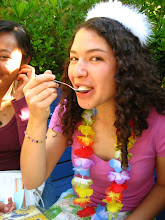
The fun part about the feast was the people. Our 22 students were there, as well as our three professors, George, Brent, and Pat, the graduate student instructors, Maya, David, and Steph, a whole bunch of Biocode researchers (working on coding DNA for every animal and plant on the island), as well as the Polynesian staff of the station and their families. It was so nice to hang out with the professors and listen to their (often inappropriate) jokes and stories, something that is rarely done at Berkeley. Brent pointed out that we are learning how to become scientists, which includes leisure time as well (apparently to become a scientist, one must get used to drinking a lot of beer). One of the most entertaining guests was “Auntie,” Hinano’s great aunt (Hinano is married to Frank, who is one of the head administrators). Eighty-six years old, four feet tall, and not speaking a word of English or French, Auntie has the reputation of greeting people by kissing their nipples and then grabbing them in inappropriate places. Brent had in fact been to a dinner the previous night at which Auntie was in attendance, and had to request to move seats when things got a little too raunchy. Auntie actually ended up behaving very well at the feast and kept her hands to herself, although she was definitely very liberal with her kisses and enjoyed standing up every once and while and dancing a jig, particularly when someone began to play the ukulele. Hinano then gave us Tahitian dancing lessons, which was a lot of fun, and did a beautiful solo dance herself, using a table cloth as a skirt. Auntie even sang us a song.
Anyway, it was really a fun night, and now it’s time for sleep in my mosquito net covered bed. I can hear the sound of the water lapping in the bay, the chirping of crickets, and the squawking? barking? chirping? of geckos. It’s weird, I’d never heard it before, but geckos make really loud noises for their size – they kind of sound like birds. And with the occasional rooster crowing at any odd hour of day or night, as well as the crazy Polynesian drivers racing down the nearby (and only) road, it sounds like a typical night in Paradise.

Subscribe to:
Post Comments (Atom)
No comments:
Post a Comment